<br />
<b>Warning</b>:  Creating default object from empty value in <b>/www/htdocs/w00c90d5/v22app/wp-content/plugins/wpseo/wpseo.php</b> on line <b>14</b><br />
<?xml version="1.0" encoding="UTF-8"?>
<rss version="2.0"
	xmlns:content="http://purl.org/rss/1.0/modules/content/"
	xmlns:wfw="http://wellformedweb.org/CommentAPI/"
	xmlns:dc="http://purl.org/dc/elements/1.1/"
	xmlns:atom="http://www.w3.org/2005/Atom"
	xmlns:sy="http://purl.org/rss/1.0/modules/syndication/"
	xmlns:slash="http://purl.org/rss/1.0/modules/slash/"
	>

<channel>
	<title>mathehilfe24 &#187; Quadratische Gleichungen</title>
	<atom:link href="http://back.mathehilfe24.de/?cat=105&#038;feed=rss2" rel="self" type="application/rss+xml" />
	<link>http://back.mathehilfe24.de</link>
	<description>Mathe Nachhilfe Online</description>
	<lastBuildDate>Fri, 01 Feb 2013 22:45:12 +0000</lastBuildDate>
	<language>de-DE</language>
	<sy:updatePeriod>hourly</sy:updatePeriod>
	<sy:updateFrequency>1</sy:updateFrequency>
	<generator>http://wordpress.org/?v=</generator>
		<item>
		<title>Gleichung umstellen und lösen: (x+3)(x+5)=x²-9</title>
		<link>http://back.mathehilfe24.de/?p=6244</link>
		<comments>http://back.mathehilfe24.de/?p=6244#comments</comments>
		<pubDate>Thu, 15 Sep 2011 04:13:54 +0000</pubDate>
		<dc:creator>Vitali Pritzkau</dc:creator>
				<category><![CDATA[07.-Klasse]]></category>
		<category><![CDATA[08.-Klasse]]></category>
		<category><![CDATA[Binomische Formeln]]></category>
		<category><![CDATA[Gleichungen lösen]]></category>
		<category><![CDATA[Klassen]]></category>
		<category><![CDATA[Quadratische Gleichungen]]></category>
		<category><![CDATA[Themen]]></category>
		<category><![CDATA[Zahlen und Terme]]></category>
		<category><![CDATA[Ausmultiplizieren]]></category>
		<category><![CDATA[Lösungsmenge]]></category>
		<category><![CDATA[Terme]]></category>

		<guid isPermaLink="false">http://www.mathehilfe24.de/?p=6244</guid>
		<description><![CDATA[Aufgabe: Bestimme die Lösungsmenge der Gleichung (x+3)(x+5)=x²-9. In diesem Video wird erklärt, worauf zu achten ist, wenn man die Gleichung erstmal umstellt, sodass auf der einen Seite die Variable und auf der anderen Seite [...]]]></description>
			<content:encoded><![CDATA[<iframe src="http://player.vimeo.com/video/29079251?title=0&amp;byline=0&amp;portrait=0&amp;color=1D75BC&amp;autoplay=1" width="640" height="360" frameborder="0" webkitAllowFullScreen allowFullScreen></iframe><p><img src='http://back.mathehilfe24.de/wp-content/plugins/simple-post-thumbnails/timthumb.php?src=/wp-content/thumbnails/6244.jpg&amp;w=200&amp;h=150&amp;zc=1&amp;ft=jpg' alt='post thumbnail' /></p>
<p><a></a><br />
<strong>Aufgabe:</strong><br />
Bestimme die Lösungsmenge der Gleichung (x+3)(x+5)=x²-9. </p>
<p>In diesem Video wird erklärt, worauf zu achten ist, wenn man die Gleichung erstmal umstellt, sodass auf der einen Seite die Variable und auf der anderen Seite die Zahl ist. </p>
<p>Dies ist ein Wunschvideo für Kevin.</p>
<p align="right">s185</p>
<p>Viel Erfolg mit Mathehilfe24<br />
Dein Mathehilfe24‑Team</p>
<p><strong>Mathehilfe24…mit UNS kannst DU rechnen</strong></p>
]]></content:encoded>
			<wfw:commentRss>http://back.mathehilfe24.de/?feed=rss2&#038;p=6244</wfw:commentRss>
		<slash:comments>1</slash:comments>
		</item>
		<item>
		<title>Quadratische Gleichungen lösen &#8211; pq-Formel anwenden</title>
		<link>http://back.mathehilfe24.de/?p=6138</link>
		<comments>http://back.mathehilfe24.de/?p=6138#comments</comments>
		<pubDate>Fri, 02 Sep 2011 17:39:38 +0000</pubDate>
		<dc:creator>Vitali Pritzkau</dc:creator>
				<category><![CDATA[08.-Klasse]]></category>
		<category><![CDATA[Gleichungen lösen]]></category>
		<category><![CDATA[Klassen]]></category>
		<category><![CDATA[Quadratische Gleichungen]]></category>
		<category><![CDATA[Themen]]></category>
		<category><![CDATA[Zahlen und Terme]]></category>
		<category><![CDATA[Brüche]]></category>
		<category><![CDATA[pq-Formel]]></category>

		<guid isPermaLink="false">http://www.mathehilfe24.de/?p=6138</guid>
		<description><![CDATA[Wie man Gleichungen löst, zeigt Stefan in diesem Videoclip. Es ist wichtig, strukturiert vorzugehen. In diesem Beispiel löst er eine Gleichung so weit, bis er auf die pq-Formel stößt. Das Besondere an diesem Clip: [...]]]></description>
			<content:encoded><![CDATA[<iframe src="http://player.vimeo.com/video/28507193?title=0&amp;byline=0&amp;portrait=0&amp;color=1D75BC&amp;autoplay=1" width="640" height="360" frameborder="0"></iframe><p><img src='http://back.mathehilfe24.de/wp-content/plugins/simple-post-thumbnails/timthumb.php?src=/wp-content/thumbnails/6138.jpg&amp;w=200&amp;h=150&amp;zc=1&amp;ft=jpg' alt='post thumbnail' /></p>
<p>Wie man Gleichungen löst, zeigt Stefan in diesem Videoclip. Es ist wichtig, strukturiert vorzugehen. In diesem Beispiel löst er eine Gleichung so weit, bis er auf die pq-Formel stößt. Das Besondere an diesem Clip: Hier ist die unbekannte Variable x sowohl im Zähler als auch im Nenner, sowohl auf der linken als auch auf der rechten Seite des Gleichzeichens. Hört sich gerade zugegeben etwas spannender an als es letzten Endes ist <img src='http://back.mathehilfe24.de/wp-includes/images/smilies/icon_smile.gif' alt=':-)' class='wp-smiley' /> .</p>
<p>Viel Erfolg mit Mathehilfe24<br />
Dein Mathehilfe24-Team</p>
<p style="text-align: right;">s165</p>
<p><strong>Mathehilfe24 &#8230;mit UNS kannst DU rechnen!</strong></p>
]]></content:encoded>
			<wfw:commentRss>http://back.mathehilfe24.de/?feed=rss2&#038;p=6138</wfw:commentRss>
		<slash:comments>0</slash:comments>
		</item>
		<item>
		<title>Polynomdivision 3 &#8211; Gleichung lösen &#8211; pq Formel anwenden</title>
		<link>http://back.mathehilfe24.de/?p=5900</link>
		<comments>http://back.mathehilfe24.de/?p=5900#comments</comments>
		<pubDate>Mon, 22 Aug 2011 22:03:20 +0000</pubDate>
		<dc:creator>Vitali Pritzkau</dc:creator>
				<category><![CDATA[10.-Klasse]]></category>
		<category><![CDATA[Gleichungen lösen]]></category>
		<category><![CDATA[Klassen]]></category>
		<category><![CDATA[Polynomdivision]]></category>
		<category><![CDATA[Quadratische Gleichungen]]></category>
		<category><![CDATA[Themen]]></category>
		<category><![CDATA[Nullstellen]]></category>
		<category><![CDATA[Polynomdi]]></category>
		<category><![CDATA[pq-Formel]]></category>

		<guid isPermaLink="false">http://www.mathehilfe24.de/?p=5900</guid>
		<description><![CDATA[Aufgabe: Löse folgende Gleichung: -3x³+4x²+8=0. In diesem Video wird anhand eines Beispiels erklärt, wie man mithilfe der Polynomdivision eine Gleichung löst, bei der die Polynomdivision notwendig ist. Im zweiten Schritt wird die pq-Formel angewandt, [...]]]></description>
			<content:encoded><![CDATA[<iframe src="http://player.vimeo.com/video/28106414?title=0&amp;byline=0&amp;portrait=0&amp;color=1D75BC&amp;autoplay=1" width="640" height="360" frameborder="0"></iframe><p><img src='http://back.mathehilfe24.de/wp-content/plugins/simple-post-thumbnails/timthumb.php?src=/wp-content/thumbnails/5900.jpg&amp;w=200&amp;h=150&amp;zc=1&amp;ft=jpg' alt='post thumbnail' /></p>
<p><a></a><br />
<strong>Aufgabe:</strong> Löse folgende Gleichung: -3x³+4x²+8=0.</p>
<p>In diesem Video wird anhand eines Beispiels erklärt, wie man mithilfe der Polynomdivision eine Gleichung löst, bei der die Polynomdivision notwendig ist. Im zweiten Schritt wird die pq-Formel angewandt, um weitere Lösungen zu finden. </p>
<p>Bei der Polynomdivision geht es darum, dass ein Polynom (also ein Term, bei dem mindestens ein x einen höheren Exponenten als 1 besitzt) geteilt wird. Wie das funktioniert seht ihr in diesem Video. Ein ausführliches Grundlagenvideo zum Thema Linearfaktorzerlegung und der damit zusammenhängenden Polynomdivision ist das Video S46. Einfach in die Suchmaske eingeben, anschauen und Du bist bestens für dieses Video vorbereitet.</p>
<p>Viel Erfolg mit Mathehilfe24<br />
Dein Mathehilfe24-Team</p>
<p style="text-align: right;">s148</p>
<p><strong>Mathehilfe24 &#8230;mit UNS kannst DU rechnen!</strong></p>
]]></content:encoded>
			<wfw:commentRss>http://back.mathehilfe24.de/?feed=rss2&#038;p=5900</wfw:commentRss>
		<slash:comments>0</slash:comments>
		</item>
		<item>
		<title>Parabel &#8211; Scheitelpunkt Symmetrieachse bestimmen</title>
		<link>http://back.mathehilfe24.de/?p=4418</link>
		<comments>http://back.mathehilfe24.de/?p=4418#comments</comments>
		<pubDate>Sat, 07 May 2011 12:05:23 +0000</pubDate>
		<dc:creator>Vitali Pritzkau</dc:creator>
				<category><![CDATA[08.-Klasse]]></category>
		<category><![CDATA[09.-Klasse]]></category>
		<category><![CDATA[Funktionen]]></category>
		<category><![CDATA[Gleichungen lösen]]></category>
		<category><![CDATA[Klassen]]></category>
		<category><![CDATA[Quadratische Funktionen]]></category>
		<category><![CDATA[Quadratische Gleichungen]]></category>
		<category><![CDATA[Themen]]></category>
		<category><![CDATA[Nullstellen]]></category>
		<category><![CDATA[Parabel]]></category>
		<category><![CDATA[Scheitelpunkt]]></category>
		<category><![CDATA[Symmetrie]]></category>
		<category><![CDATA[Symmetrieachse]]></category>

		<guid isPermaLink="false">http://www.mathehilfe24.de/?p=4418</guid>
		<description><![CDATA[&#160; AUFGABE: Bestimme zunächst die Nullstellen der Funktion (Parabel). Bestimme dann den Scheitelpunkt und die Symmetrieachse der Parabel. Ist der Scheitelpunkt eine Parabel? &#160; &#160; &#160; Wie bestimme ich den Scheitelpunkt einer Parabel? Wie [...]]]></description>

			<content:encoded><![CDATA[<iframe src="http://player.vimeo.com/video/23405853?title=0&amp;byline=0&amp;portrait=0&amp;autoplay=1" width="640" height="360" frameborder="0"></iframe><p>s130_Parabel - Nullstellen, Symmetrie, Scheitelpunkt bestimmen_s130<p><img src='http://back.mathehilfe24.de/wp-content/plugins/simple-post-thumbnails/timthumb.php?src=/wp-content/thumbnails/4418.jpg&amp;w=200&amp;h=150&amp;zc=1&amp;ft=jpg' alt='post thumbnail' /></p>
<p>&nbsp;</p>
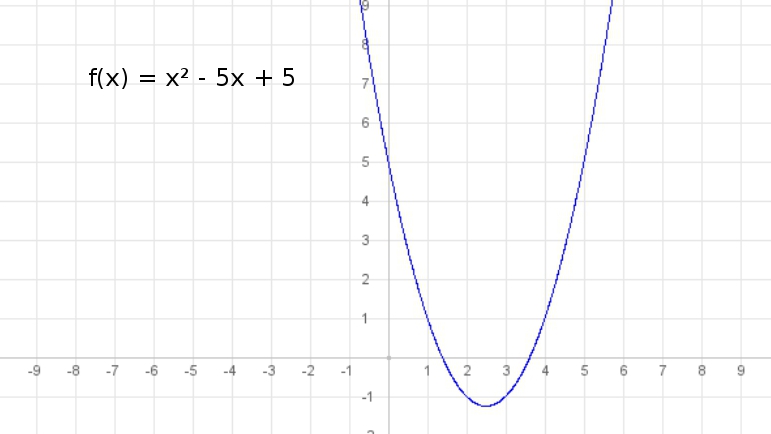
<h2>AUFGABE: Bestimme zunächst die Nullstellen der Funktion (Parabel).<br />
Bestimme dann den Scheitelpunkt und die Symmetrieachse der Parabel. Ist der Scheitelpunkt eine Parabel?</h2>
<p>&nbsp;</p>
<h1 style="text-align: center;"><img src="http://back.mathehilfe24.de/wp-content/plugins/wpmathpub/phpmathpublisher/img/math_988_09001c1b7b92d0e18a49acc350856516.png" style="vertical-align:-12px; display: inline-block ;" alt="f(x)=x²-5x+5" title="f(x)=x²-5x+5"/></h1>
<p>&nbsp;</p>
<p>&nbsp;</p>
<div id="attachment_4423" class="wp-caption alignright" style="width: 310px"><a href="http://www.mathehilfe24.de/wp-content/uploads/2011/05/s130_Bild21.jpg"><img class="size-medium wp-image-4423 " title="Parabel Schaubild" src="http://www.mathehilfe24.de/wp-content/uploads/2011/05/s130_Bild21-300x168.jpg" alt="Parabel Quadratische Funktion" width="300" height="168" /></a><p class="wp-caption-text">f(x) = x² - 5x + 5</p></div>
<h3>Wie bestimme ich den Scheitelpunkt einer Parabel? Wie bestimme ich die Nullstellen einer Parabel? Und wie finde ich die Symmetrieachse einer Parabel? Das wird Dir in diesem Clip erklärt.</h3>
<p>&nbsp;</p>
<h3>Dies ist ein Wunschvideoclip für Daniel.</h3>
<p style="text-align: right;">S130</p>
<h3>Viel Erfolg mit Mathehilfe24<br />
Dein mathehilfe24-Team</h3>
<p>&nbsp;</p>
<h4>Mit diesem Taschenrechner kannst Du einfach mal schnell nachrechnen.</h4>
<p><iframe style="border: 1px solid silver;" src="http://embed.web2.0rechner.de/?" scrolling="no" width="590" height="390"></iframe></p>
]]></content:encoded>
			<wfw:commentRss>http://back.mathehilfe24.de/?feed=rss2&#038;p=4418</wfw:commentRss>
		<slash:comments>2</slash:comments>
		</item>
		<item>
		<title>Binomische Formeln 1</title>
		<link>http://back.mathehilfe24.de/?p=418</link>
		<comments>http://back.mathehilfe24.de/?p=418#comments</comments>
		<pubDate>Fri, 29 Oct 2010 21:28:53 +0000</pubDate>
		<dc:creator>Vitali Pritzkau</dc:creator>
				<category><![CDATA[08.-Klasse]]></category>
		<category><![CDATA[Binomische Formeln]]></category>
		<category><![CDATA[Quadratische Gleichungen]]></category>
		<category><![CDATA[Zahlen und Terme]]></category>
		<category><![CDATA[Herleitung]]></category>

		<guid isPermaLink="false">http://www.mathehilfe24.de/?p=418</guid>
		<description><![CDATA[Es gibt insgesamt drei binomische Formeln. 1.) (a+b)² = a² + 2ab + b² 2.) (a-b)² = a² &#8211; 2ab + b² 3.) (a+b) * (a-b) = a² &#8211; b² Aber wie kommt man [...]]]></description>
			<content:encoded><![CDATA[<iframe src="http://player.vimeo.com/video/16021247?title=0&amp;byline=0&amp;portrait=0" width="640" height="480" frameborder="0"></iframe><p>s2_Binomische Formeln 1_s2<p><img src='http://back.mathehilfe24.de/wp-content/plugins/simple-post-thumbnails/timthumb.php?src=/wp-content/thumbnails/418.jpg&amp;w=200&amp;h=150&amp;zc=1&amp;ft=jpg' alt='post thumbnail' /></p>
<p>Es gibt insgesamt drei binomische Formeln.</p>
<p>1.) (a+b)² = a² + 2ab + b²<br />
2.) (a-b)² = a² &#8211; 2ab + b²<br />
3.) (a+b) * (a-b) = a² &#8211; b²</p>
<p>Aber wie kommt man darauf?</p>
<p>In diesem Videoclip leitet Stefan alle drei binomischen Formeln her.</p>
<p style="text-align: right;">S2</p>
<p><strong>Viel Erfolg mit Mathehilfe24</strong><br />
<strong> Dein Mathehilfe24-Team</strong></p>
]]></content:encoded>
			<wfw:commentRss>http://back.mathehilfe24.de/?feed=rss2&#038;p=418</wfw:commentRss>
		<slash:comments>0</slash:comments>
		</item>
		<item>
		<title>Binomische Formeln_Herleitung 2</title>
		<link>http://back.mathehilfe24.de/?p=330</link>
		<comments>http://back.mathehilfe24.de/?p=330#comments</comments>
		<pubDate>Sat, 23 Oct 2010 19:53:23 +0000</pubDate>
		<dc:creator>Vitali Pritzkau</dc:creator>
				<category><![CDATA[07.-Klasse]]></category>
		<category><![CDATA[08.-Klasse]]></category>
		<category><![CDATA[Binomische Formeln]]></category>
		<category><![CDATA[Klassen]]></category>
		<category><![CDATA[Quadratische Gleichungen]]></category>
		<category><![CDATA[Zahlen und Terme]]></category>
		<category><![CDATA[Herleitung]]></category>

		<guid isPermaLink="false">http://www.mathehilfe24.de/?p=330</guid>
		<description><![CDATA[Die binomischen Formeln sind zwar bei vielen Schülern verhasst, aber so schwer sind sie eigentlich gar nicht. Wenn man versteht, wie sie sich herleiten, fällt es vielleicht auch leichter, sich mit ihnen anzufreunden. Stefan [...]]]></description>
			<content:encoded><![CDATA[<iframe src="http://player.vimeo.com/video/16021366?title=0&amp;byline=0&amp;portrait=0" width="640" height="480" frameborder="0"></iframe><p>s3_Binomische Formeln 2_s3<p><img src='http://back.mathehilfe24.de/wp-content/plugins/simple-post-thumbnails/timthumb.php?src=/wp-content/thumbnails/330.jpg&amp;w=200&amp;h=150&amp;zc=1&amp;ft=jpg' alt='post thumbnail' /></p>
<p>Die binomischen Formeln sind zwar bei vielen Schülern verhasst, aber so schwer sind sie eigentlich gar nicht. Wenn man versteht, wie sie sich herleiten, fällt es vielleicht auch leichter, sich mit ihnen anzufreunden. Stefan versucht in diesem Videoclip, euch die binomischen Formeln ein Stück weit näher zu bringen. Im einzelnen lauten die binomischen Formeln wie folgt:</p>
<p>1.) (a + b)² = a² + 2ab + b²<br />
2.) (a &#8211; b)² = a² &#8211; 2ab + b²<br />
3.) (a + b) (a &#8211; b) = a² &#8211; b²</p>
<p style="text-align: right;">S3</p>
<p style="text-align: left;"><strong>Viel Erfolg beim Mathe lernen</strong><br />
<strong>Dein Mathehilfe24-Team</strong></p>
]]></content:encoded>
			<wfw:commentRss>http://back.mathehilfe24.de/?feed=rss2&#038;p=330</wfw:commentRss>
		<slash:comments>0</slash:comments>
		</item>
	</channel>
</rss>